Author: Store Manager A
This time I will describe the routine from leaving home to packing away. I am starting to wonder whether a video would explain it better, but this is a precious opportunity, so I will keep putting full effort into conveying kayak fishing's appeal in writing. Let's begin.
Off We Go Kayak Fishing!
I generally work backward from arriving an hour before sunrise. Departure varies by season: around 2:30 a.m. in summer and 4:30 a.m. in winter.
Kayaking lets you experience seasonal change with all five senses. That is one reason I love it. Nature lovers will understand that feeling, though it also brings dilemmas for an angler.
First, sleep shortage is worse in summer. When I shore-jigged for cutlassfish, arriving at 11 p.m. was already too late to find space; anglers' stamina is extraordinary. Kayaking largely avoids that competition, making it relatively easier (not easy). Still, launching at sunrise for the active dawn period means leaving early. Winter allows more sleep, though never enough, but pre-dawn cold is severe. Unless I warm up for around 30 minutes after sunrise, numb fingers prevent opening split rings or tying line. Winter trips therefore run later. I have a two-and-a-half-year-old child and try to keep fishing short to balance family and hobby. In summer I sometimes launch at 5, catch the target in an hour and get home at 7–8 saying “I'm home—good morning!” Winter usually means launching at 7:30–8 and returning before noon. I appreciate my wife's uncomplaining support and use it as motivation to repay her through housework and childcare. Even so, the longer I spend away, the more a little guilt remains.
Final Gear & Home Security Check
It may seem obvious, but make a final check before leaving. Excitement has blinded me enough to cause several unbelievable mistakes. Here are a few.
Kayak
You are right to be puzzled, but I once forgot my kayak on a kayak fishing trip. I still cannot explain it. After driving an hour to meet friends and cheerfully saying good morning, the first reply was, “Where's your kayak?” There was none on the roof. I was so shocked that I went home and took to bed.
Fish Finder Batteries
A surprisingly painful omission. I normally stock four packs of four batteries in my tackle box and life jacket, but that day every pack was empty.
When you rely on a fish finder, losing it feels like being dropped in a desert without a map. Fishing felt empty, but worse, I could not tell my position or drifting speed, which was frightening. Unable to concentrate, I ended early.
Life Jacket
This omission tests your judgment. A life jacket is indispensable for kayak fishing. Forget it and the day is over unless you can borrow a spare; otherwise, go home. As a beginner I did not understand this and thought I could simply be careful. I deeply regret that attitude. Once, preparing to launch with friends 15 minutes from home, I realized I had forgotten mine. They immediately said, “That's serious! We'll wait—go get it!” I am lucky in my friends. That exchange greatly deepened my respect for life jackets, even though it was my first time forgetting one.
Always prepare a flag and life jacket. If you go out missing either and something happens, criticism is inevitable and affects many others. “I won't have an accident” is never a valid excuse.
My Front Door Was Open
Not unlocked—wide open. This was when I was single and new to kayak fishing. Now with a wife and child, I have decided I would quit if I repeated it. The squid I caught that day had no taste. For days I anxiously checked my bankbook. It left me compulsively pointing at and saying aloud that the door is locked and putting the key in a particular pocket. Fortunately nothing was stolen, but I seriously wondered what I could possibly tell the police if something had happened.
Do Not Speed; Take Breaks as Needed
Roads are empty before dawn and it is tempting to speed, but be especially careful then. Excitement about fishing already leaves you distracted, and that is when accidents happen. Deer often appear on the road to my main spot. Hitting one could damage many things. Wildlife is simply trying to live; we cannot hold it responsible, so we humans must take care. Drive cautiously, especially on mountain roads.
I also think a convenience-store toilet stop matters. Carrying bodily waste seems to make seasickness more likely, and an urgent need offshore is an emergency. Forgive the crude story, but once I had an unbearable urge at sea. Now I might have the nerve to enter the water and use the vast natural washlet, feeling guilty for directly polluting the sea; back then I did not. I hurried ashore, left all my gear on the beach and drove 2 minutes to a store, praying. Nothing was stolen, a miracle. It was clearly not commendable: if a passerby, especially a child, had touched a hook and been hurt, I would have been responsible.
On Arrival, Check the Sea First!
Even predictions from Windy, Yahoo Weather and tide graphs can be wrong, with rough seas or large swell. Before unloading, inspect the sea yourself and make the final launch decision. Criteria vary by location and experience, but I cancel, however disappointing, if even one applies: howling wind, many whitecaps, high short-period breaking waves with long wash, or thick black clouds suggesting lightning. Kayak and SUP accidents have risen sharply: 20 people in 2017 and 68 in 2021, according to Japan Coast Guard statistics. Most involve inability to recover from capsizing or return through insufficient strength or skill. I cannot know what people thought before launching, but as a fellow enthusiast I suspect “It should be fine; I've come all this way” sometimes plays a part. I feel that temptation too. Precisely because I understand it, courage to cancel is essential. The sea is a different world from land.
Unload, Then Prepare Yourself for Sunrise
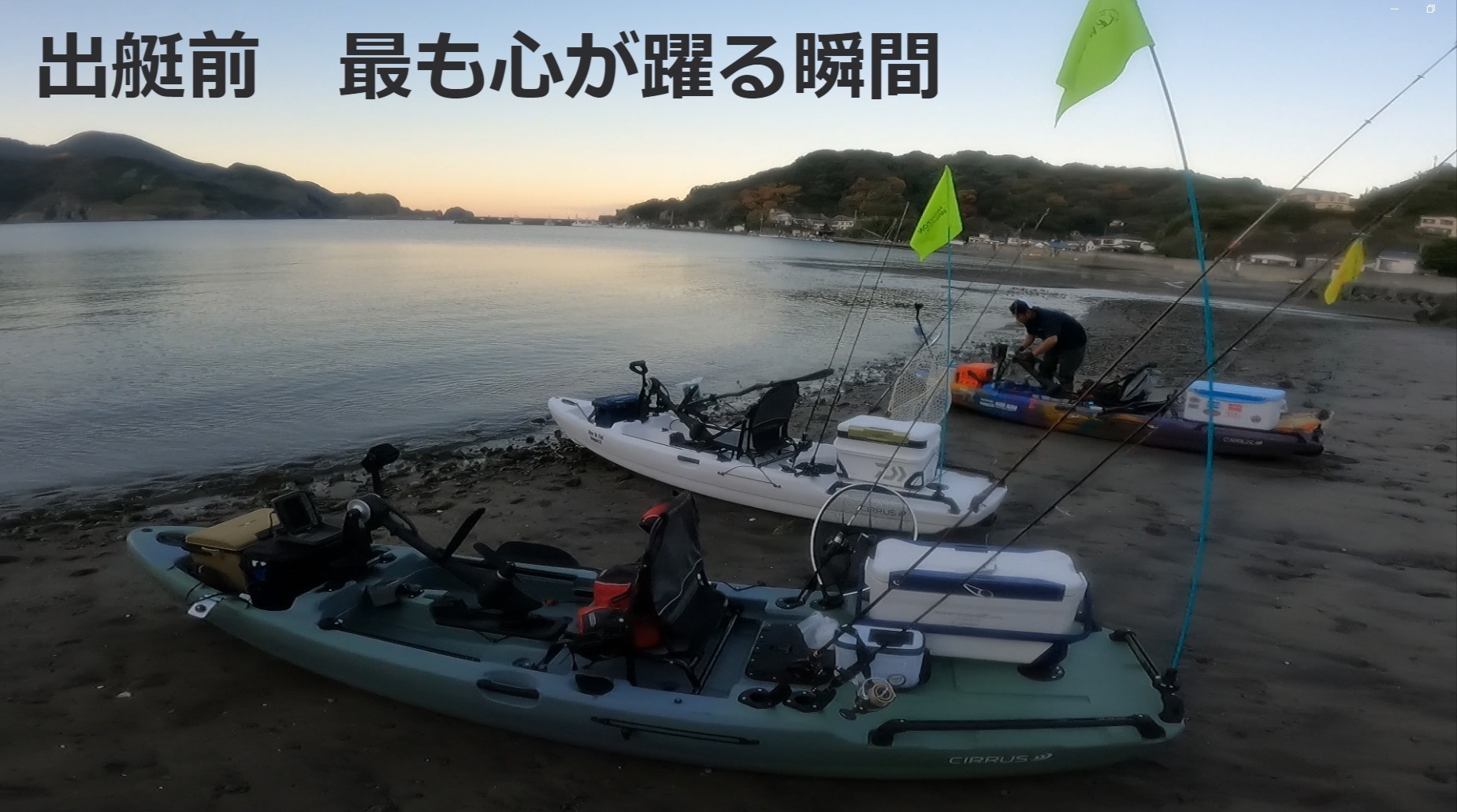
There is no law setting a kayak launch time, nor legal requirements for flags or life jackets. Kayak fishing carries risks while necessary legislation has not caught up. Many boundaries are therefore left to each angler's conscience.
For visibility, wait until sunrise. Some anglers leave in dim light; opinions differ, but I do not consider it desirable. Without a radar reflector, a kayak does not appear on ship radar; even with one it may not. If visual sighting is the only way to be found, avoiding pre-sunrise launches is the reasonable conclusion.
Some may think we can simply avoid ships ourselves, but distances are hard to judge at sea without landmarks. A fishing boat that seemed distant can suddenly be close. With no road markings, its direction is hard to read: right or left? While fishing, attention naturally focuses on your hands. What if you look up and find a fishing boat close by? In deep water, can you retrieve your line in time? What if a big fish is hooked and pulls the kayak beyond your control? These possibilities alone leave virtually no benefit to launching in dim light.
The Japan Coast Guard also advises against launching in darkness, saying “Avoid navigating at night.” For details, see the Japan Coast Guard website. It is very informative.
Keep Motion Sickness Medicine Available
As a former oceanography student with countless boat trips, I need not fear seasickness—or so I would like to say. In truth, I get seasick easily, so medication is essential for my kayak fishing. Mine follows some patterns. They will not apply to everyone, but here are the conditions I have identified.
Lack of Sleep
The leading cause for me. Below 4.5 hours' sleep, seasickness is very likely; below 3 hours, almost certain. I therefore ensure a minimum amount. I do not stay overnight beforehand—not to criticize those who do. My SUV is cramped, few seasons suit sleeping in a car without a generator for comfort, and sleep quality suffers. My familiar bed is best, though I still dream of a larger vehicle converted for comfortable overnight stays.
Food
Late dinners, roughly after 9 p.m., alcohol, greasy food and meat are very likely to make me seasick. Surprisingly, seaweed on the day does too: seaweed-wrapped rice balls sharply increase my risk. Hence the cornflakes mentioned earlier. I avoid sweet drinks, choosing water or tea, and always black coffee to wake up. This sounds health-conscious, but it is not: I am writing this at 11:53 p.m. with a sugar doughnut and milky coffee.
Needing the Toilet
For some reason, an unemptied bowel or bladder increases my seasickness. I do not know whether there is a medical explanation.
Large Swell
This likely affects many people. Long-period, large swell moves the body up and down, creating an unpleasant floating sensation and nausea. I sometimes cancel even without wind if a typhoon offshore produces this swell.
What If You Become Seasick?
Return to shore promptly. Insisting on one fish because you came all this way is a poor choice. Seasickness impairs judgment; vomiting drains energy. Neither pedaling nor paddling works at full strength when you are ill.
Seasickness Prevention Items
I favor Aneron. Of several products tried, it works best for me. I always take it, even in calm seas, to enjoy the trip fully. Taking it 30 minutes before launching works well. An unsolicited shopping tip: Amazon sales regularly make it very cheap, so I stock up then. I can no longer manage kayak fishing without it.
Next comes fishing through packing away, completing a day of kayak fishing. Thank you again for reading to the end.
Please visit my YouTube channel too.
⇒https://www.youtube.com/channel/UCdlcmz4tCRCSsKZaV9AySKA